Employees are already using AI. Give them rules before it becomes a problem.
The AI Use Controls Module gives small organizations editable policies, use rules, approval forms, employee guidance, and review procedures so teams can use AI productively without turning client data, confidential information, or business decisions into uncontrolled experiments.
Built for owners, operations leaders, managing partners, HR, IT, compliance, nonprofits, agencies, professional services firms, and consultants serving SMB clients.
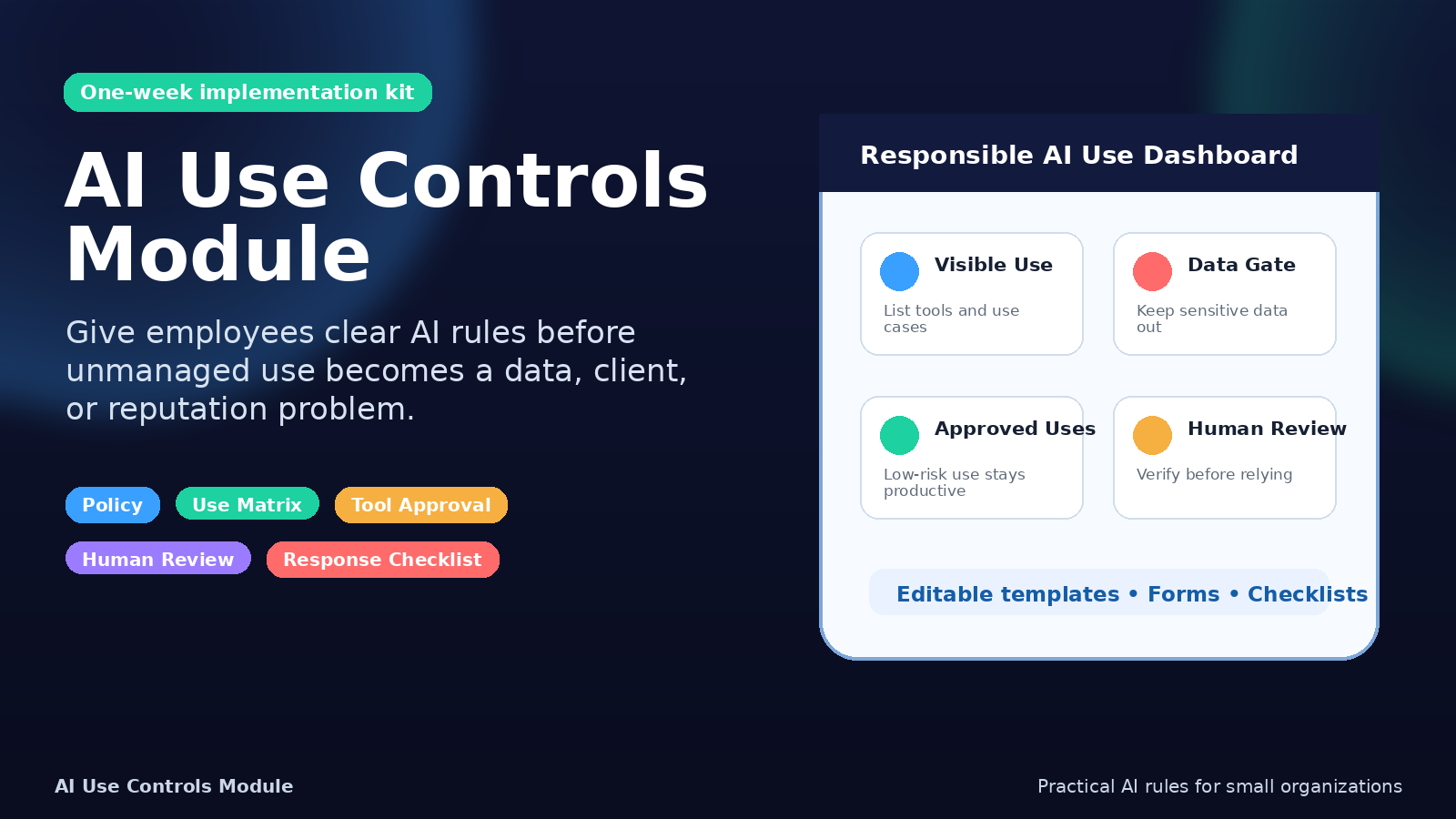
Unmanaged AI use is not just an IT issue. It is an operating risk.
Most small organizations do not need an enterprise AI governance program. They need clear operating rules: what employees may use AI for, what information must never be entered, which tools require approval, and how AI-generated outputs must be reviewed before use.
- Employees paste client, customer, employee, legal, financial, health, or confidential business data into public AI tools.
- AI-generated content is sent to clients, vendors, regulators, boards, donors, or the public without review.
- Teams use unapproved AI browser extensions, meeting bots, document analyzers, image tools, or SaaS AI features without leadership visibility.
- Managers are left guessing whether a use case is safe, restricted, prohibited, or requires approval.
- A written AI acceptable use policy employees can understand and follow.
- A clear approved, restricted, and prohibited AI use matrix for everyday decisions.
- A lightweight tool approval process that does not require a full governance department.
- A human review procedure so AI assists work without becoming the final decision-maker.
Make AI use visible, manageable, and easier to explain.
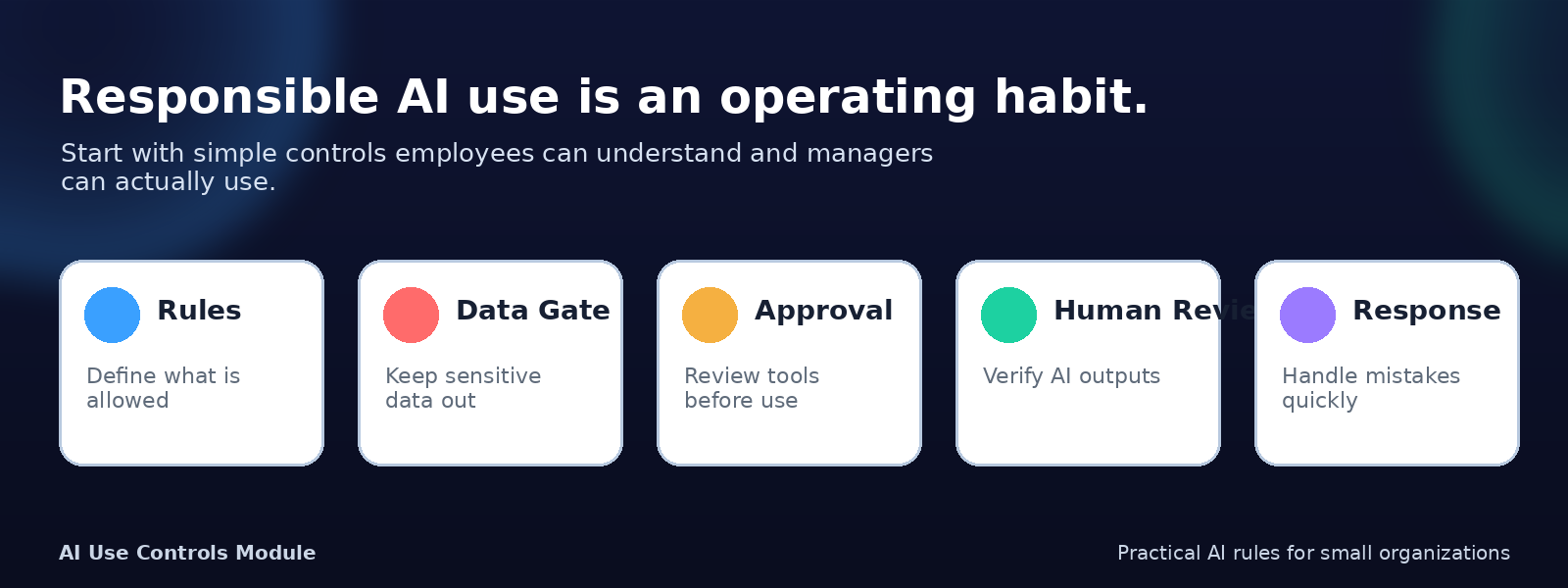
This kit turns AI from an informal employee habit into a simple business control system. The goal is not to ban AI. The goal is to let employees benefit from it while protecting confidential information, client trust, and business judgment.
Employees know what AI may be used for, what is restricted, and what is prohibited.
Staff have direct guidance on sensitive data that must not be entered into unapproved tools.
Managers have a practical way to approve, restrict, or reject AI tools and use cases.
AI outputs are checked before they affect clients, employees, finances, legal matters, or public communications.
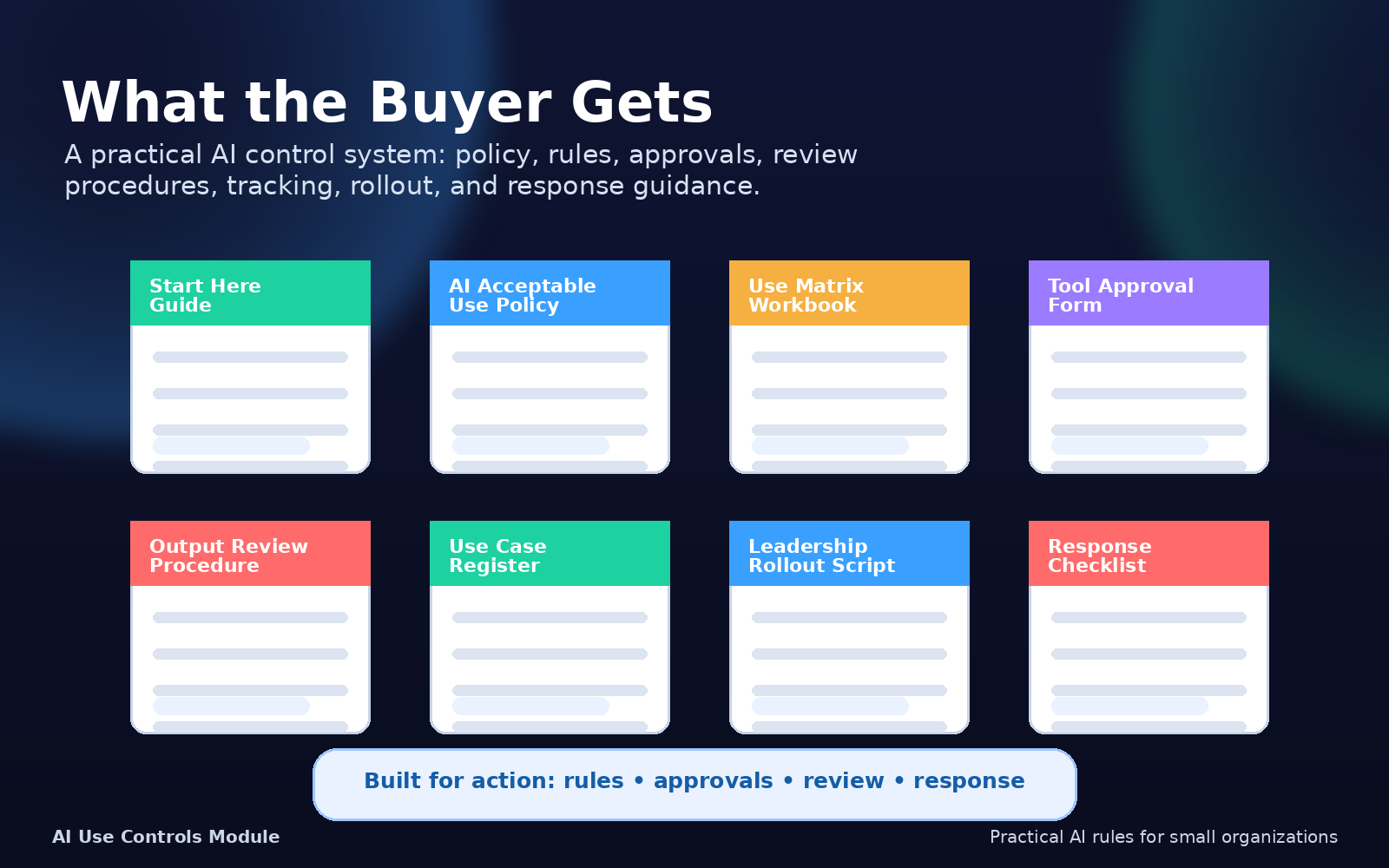
A complete lightweight AI use control system.
Each component works on its own, but together they give the buyer an operating model: policy, rules, tool approval, output review, employee guidance, tracking, rollout, and response.
Built for organizations that handle sensitive information but do not have a mature AI governance team.
The kit is designed for practical business implementation. It gives smaller teams enough structure to reduce risk without forcing them into an enterprise compliance program.
Professional services firms
Law firms, accounting firms, consultants, agencies, eDiscovery providers, managed service providers, and financial advisory firms.
Operationally lean organizations
Small businesses, nonprofits, municipal offices, public-sector contractors, SaaS startups, construction firms, and office/accounting teams.
Responsible internal leaders
Owners, COOs, office managers, HR managers, IT leaders, managing partners, executive directors, compliance managers, and fractional advisors.
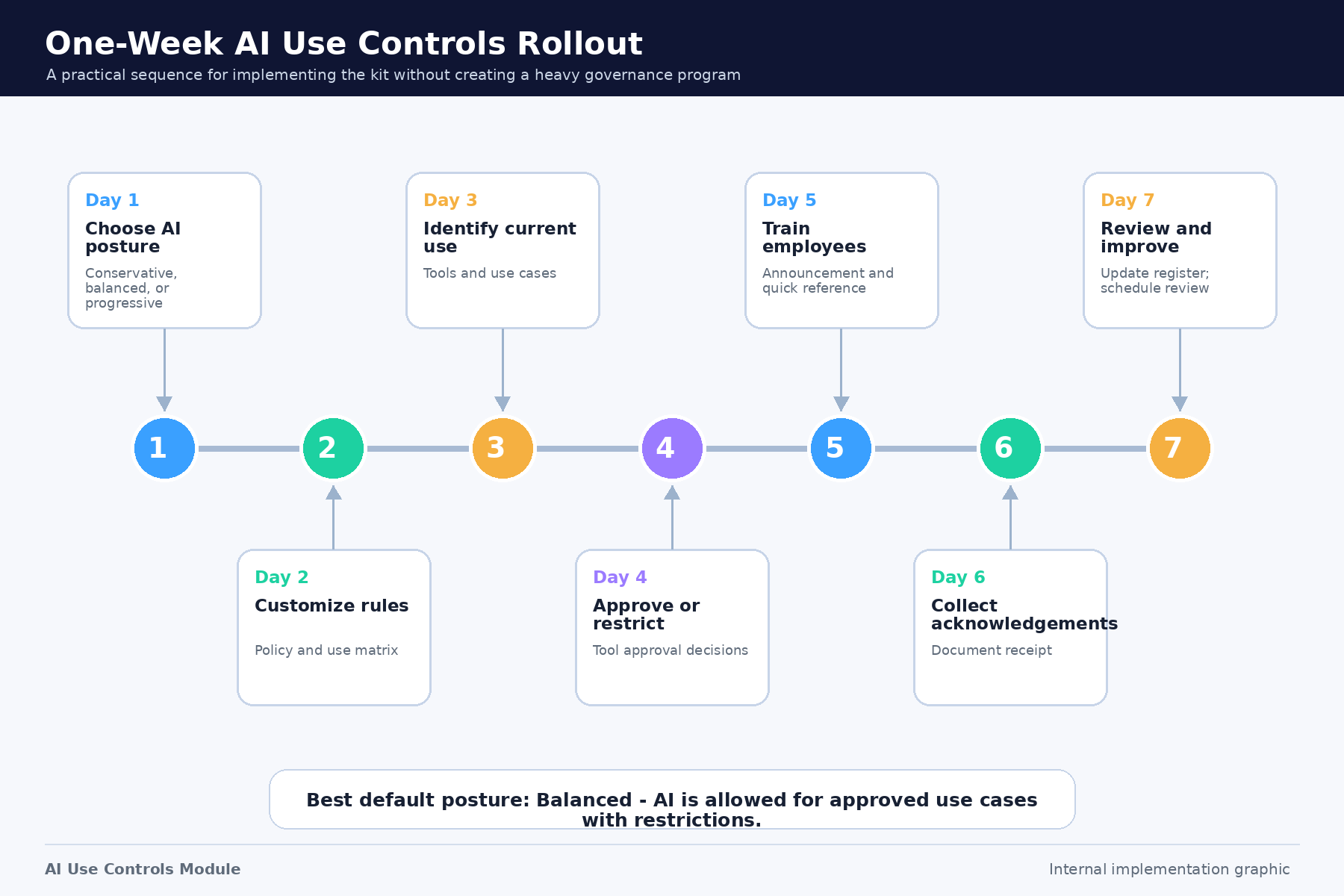
Give your organization clear AI rules in one week or less.
The kit is organized around a practical seven-day rollout. Use the full sequence for a stronger implementation, or use the minimum viable rollout when the priority is getting basic rules in place quickly.
More than a policy template. Less than a heavy governance program.
A policy alone does not tell employees what to do tomorrow. This kit combines the policy with practical decision support, approval workflow, review expectations, training language, tracking, and response guidance.
Suggested price for the full editable version with Word documents, Excel registers, staff rollout materials, and implementation graphics.
- Editable policy and procedure documents
- Practical approval and review forms
- Use case tracking workbook
- Leadership rollout and training language
- Employee-facing quick guidance and internal graphics
Replace the button URL with your Stripe, Gumroad, WooCommerce, ThriveCart, Lemon Squeezy, or other checkout link.
The buyer gets something they can actually roll out: rules, forms, tracking, announcement language, and response steps.
The kit makes clear that it is not legal advice, not a certification, and not a substitute for professional review when regulated or high-risk issues apply.
MSPs, vCIOs, fractional CISOs, compliance consultants, and operations advisors can use it as a structured starter module with clients.
Use this block for a payment button, guarantee language, or short testimonial once available.
BUY_BUTTON_EMBED_GOES_HERECommon buyer questions
Is this meant to ban AI at work?
No. The kit is designed to help organizations allow productive AI use while setting boundaries for sensitive data, tool approval, human review, and higher-risk use cases.
Is this a complete AI governance program?
No. It is a practical starter control system for small organizations. It does not replace legal, privacy, security, HR, or compliance review where those issues apply.
What kinds of AI tools does it cover?
It is written broadly for generative AI tools, including ChatGPT, Copilot, Gemini, Claude, Perplexity, embedded AI features in SaaS products, transcription tools, document analyzers, browser extensions, image generators, and similar tools.
Can the documents be edited?
Yes. The kit is intended to be delivered as editable Word documents and Excel-compatible trackers, with optional PDF versions for distribution.
Who should implement it?
Owners, operations leaders, office managers, HR, IT, compliance, managing partners, executive directors, or consultants can implement the kit. Very small organizations can use the minimum viable rollout path.
What is the fastest version to roll out?
Customize the AI Acceptable Use Policy, adopt the use matrix, send the leadership announcement, distribute the employee quick reference, and start tracking AI tools in the use case register.
Stop treating employee AI use as an informal experiment.
Give your team clear AI rules, a simple approval path, and a review process that protects client data, confidential information, employees, and business decisions.
Get the AI Use Controls Module